Punjab, India
Punjab ( i/pʌnˈdʒɑːb/) is a state in North India, forming part of the larger Punjab region. The state is bordered by the Indian states ofJammu and Kashmir to the north, Himachal Pradesh to the east,Haryana to the south and southeast, Rajasthan to the southwest, and the Pakistani province of Punjab to the west. The state capital is located in Chandigarh, a Union Territory and also the capital of the neighbouring state of Haryana. The summer residence of theGovernor of Punjab is at Shimla.After the partition of India in 1947, the Punjab province of British India was divided between India and Pakistan. The Indian Punjabwas divided in 1966 with the formation of the new states of Haryana and Himachal Pradesh alongside the current state of Punjab.Sikhism and Hinduism are the predominant faiths in Punjab, adhered by around 57.7% and 38.5% of the populace, respectively.[4]Punjab is the only Sikh majority state in India.Agriculture is the largest industry in Punjab.[5] Other major industries include the manufacturing of scientific instruments, agricultural goods, electrical goods, financial services, machine tools, textiles,sewing machines, sports goods, starch, tourism, fertilisers, bicycles,garments, and the processing of pine oil and sugar. Punjab also has the largest number of steel rolling mill plants in India, which are located in "Steel Town"—Mandi Gobindgarh in the Fatehgarh Sahib district.
Contents1
[hide] Etymology
i/pʌnˈdʒɑːb/) is a state in North India, forming part of the larger Punjab region. The state is bordered by the Indian states ofJammu and Kashmir to the north, Himachal Pradesh to the east,Haryana to the south and southeast, Rajasthan to the southwest, and the Pakistani province of Punjab to the west. The state capital is located in Chandigarh, a Union Territory and also the capital of the neighbouring state of Haryana. The summer residence of theGovernor of Punjab is at Shimla.After the partition of India in 1947, the Punjab province of British India was divided between India and Pakistan. The Indian Punjabwas divided in 1966 with the formation of the new states of Haryana and Himachal Pradesh alongside the current state of Punjab.Sikhism and Hinduism are the predominant faiths in Punjab, adhered by around 57.7% and 38.5% of the populace, respectively.[4]Punjab is the only Sikh majority state in India.Agriculture is the largest industry in Punjab.[5] Other major industries include the manufacturing of scientific instruments, agricultural goods, electrical goods, financial services, machine tools, textiles,sewing machines, sports goods, starch, tourism, fertilisers, bicycles,garments, and the processing of pine oil and sugar. Punjab also has the largest number of steel rolling mill plants in India, which are located in "Steel Town"—Mandi Gobindgarh in the Fatehgarh Sahib district.
Contents1
[hide] Etymology
 |
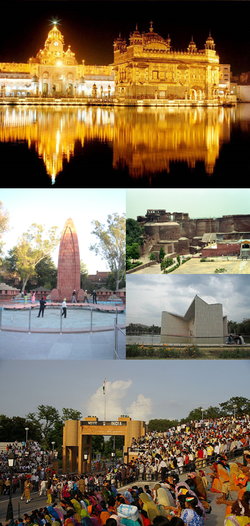

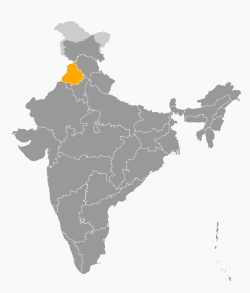


 i/pʌnˈdʒɑːb/) is a state in North India, forming part of the larger Punjab region. The state is bordered by the Indian states ofJammu and Kashmir to the north, Himachal Pradesh to the east,Haryana to the south and southeast, Rajasthan to the southwest, and the Pakistani province of Punjab to the west. The state capital is located in Chandigarh, a Union Territory and also the capital of the neighbouring state of Haryana. The summer residence of theGovernor of Punjab is at Shimla.After the partition of India in 1947, the Punjab province of British India was divided between India and Pakistan. The Indian Punjabwas divided in 1966 with the formation of the new states of Haryana and Himachal Pradesh alongside the current state of Punjab.Sikhism and Hinduism are the predominant faiths in Punjab, adhered by around 57.7% and 38.5% of the populace, respectively.[4]Punjab is the only Sikh majority state in India.Agriculture is the largest industry in Punjab.[5] Other major industries include the manufacturing of scientific instruments, agricultural goods, electrical goods, financial services, machine tools, textiles,sewing machines, sports goods, starch, tourism, fertilisers, bicycles,garments, and the processing of pine oil and sugar. Punjab also has the largest number of steel rolling mill plants in India, which are located in "Steel Town"—Mandi Gobindgarh in the Fatehgarh Sahib district.
Contents1
[hide] Etymology
i/pʌnˈdʒɑːb/) is a state in North India, forming part of the larger Punjab region. The state is bordered by the Indian states ofJammu and Kashmir to the north, Himachal Pradesh to the east,Haryana to the south and southeast, Rajasthan to the southwest, and the Pakistani province of Punjab to the west. The state capital is located in Chandigarh, a Union Territory and also the capital of the neighbouring state of Haryana. The summer residence of theGovernor of Punjab is at Shimla.After the partition of India in 1947, the Punjab province of British India was divided between India and Pakistan. The Indian Punjabwas divided in 1966 with the formation of the new states of Haryana and Himachal Pradesh alongside the current state of Punjab.Sikhism and Hinduism are the predominant faiths in Punjab, adhered by around 57.7% and 38.5% of the populace, respectively.[4]Punjab is the only Sikh majority state in India.Agriculture is the largest industry in Punjab.[5] Other major industries include the manufacturing of scientific instruments, agricultural goods, electrical goods, financial services, machine tools, textiles,sewing machines, sports goods, starch, tourism, fertilisers, bicycles,garments, and the processing of pine oil and sugar. Punjab also has the largest number of steel rolling mill plants in India, which are located in "Steel Town"—Mandi Gobindgarh in the Fatehgarh Sahib district.
Contents1
[hide] EtymologyEtymology[edit]The word Punjab is a compound of the Persian words panj (five) and āb (waters). Thus Panjāb roughly means "the land of five rivers".[6] The five rivers are the Sutlej, Beas, Ravi, Chenab andJehlum (also spelled Jhelum). Traditionally, in English, there used to be a definite article before the name, i.e. "The Punjab".[7] The name is also sometimes spelled as "Panjab". While the Greeks already referred to Punjab as Pentapotamia, an inland delta of five converging rivers,[8] the name Punjab was given to the region by the Central Asian Turkic conquerors of India, and more popularly popularized by the Turco-Mongol Mughals.[9][10][11]History[edit]Main article: History of the PunjabSee also: Punjab (region)Ancient history[edit]During the period when the epic Mahabharata was written, around 800–400 BCE, Punjab was known as Trigarta and ruled by Katochkings.[12][13] The Indus Valley Civilization spanned much of the Punjab region with cities such as Harappa (modern-day Punjab, Pakistan). The Vedic Civilization spread along the length of theSarasvati River to cover most of Northern India including Punjab. This civilization shaped subsequent cultures in the Indian subcontinent. The Punjab region was conquered by many ancient empires including the Gandhara, Nandas, Mauryas, Sungas, Kushans, Guptas, Palas, Gurjara-Pratiharas and Hindu Shahis. The furthest eastern extent of Alexander the Great's exploration was along the Indus River. Agriculture flourished and trading cities such as Jalandhar, Sangrur and Ludhiana grew in wealth.[citation needed]Due to its location, the Punjab region came under constant attack and influence from both west and east. Punjab faced invasions by the Achaemenids, Greeks, Scythians, Turks, and Afghans. This resulted in the Punjab witnessing centuries of bitter bloodshed. Its culture combines Hindu, Buddhist, Islamic, Afghan,[citation needed] Sikh and British influences.The city of Taxila, founded by Takṣa, the son of Bharat, who in turn was the brother of the Hindu deity Rama, was reputed to house Takshashila University, the oldest university in the world.[14] One of its teachers was the great Vedic thinker and politician Chanakya. Taxila was a great centre of learning and intellectual discussion during the Maurya Empire. It is today a United Nations World Heritage site.Sikhs in Punjab[edit]The roots of Sikhism began at the time of the Conquest of Northern India by Babur. His grandson, Akbar, supported religious freedom and after visiting the langar of Guru Amar Das had a favourable impression of Sikhism. As a result of his visit he donated land to the langar and had a positive relationship with the Sikh Gurus until his death in 1605.[15] His successor, Jahangir, saw the Sikhs as a political threat. He arrested Guru Arjun Dev because of Sikh support for Khusrau Mirza[16] and ordered him to be put to death by torture. Guru Arjan Dev's martyrdom led to the sixth Guru, Guru Har Gobind, declaring Sikh sovereignty in the creation of the Akal Takht and the establishment of a fort to defend Amritsar.[17]Jahangir attempted to assert authority over the Sikhs by imprisoning Guru Har Gobind at Gwalior. He felt compelled to release him when he began to suffer premonitions of an early and gruesome death. The Guru refused to be released unless the dozens of Hindu princes imprisoned with him were also granted freedom, to which Jahangir agreed. Sikhism did not have any further issues with the Mughal Empire until the death of Jahangir in 1627. His successor, Shah Jahan "took offense" at Guru Har Gobind's sovereignty and after a series of assaults on Amritsar forced the Sikhs to retreat to theSivalik Hills.[17] Guru Har Gobind's successor, Guru Har Rai maintained the guruship in the Sivalik Hills by defeating local attempts to seize Sikh land and taking a neutral role in the power struggle between Aurangzeb and Dara Shikoh for control of the Timurid dynasty. The ninth Guru, Guru Tegh Bahadur, moved the Sikh community to Anandpur and traveled extensively to visit and preach in Sikh communities in defiance of Mughal rule. He aided Kashmiri Pandits in avoidingconversion to Islam and was arrested and confronted by Aurangzeb. When offered a choice between conversion or death, he chose to die rather than compromise his principles and was executed.[18] Guru Gobind Singh assumed the guruship in 1675 and to avoid battles with Sivalik Hill Rajas moved the guruship to Paunta. He built a large fort to protect the city and garrisoned an army to protect it. The growing power of the Sikh community alarmed Sivalik Hill Rajas, who attempted to attack the city, but the Guru's forces routed them at the Battle of Bhangani. He moved on to Anandpur and established theKhalsa, a collective army of baptised Sikhs, on 30 March 1699. The establishment of the Khalsa united the Sikh community against various Mughal-backed claimants to the guruship.[19]In 1701, a combined army composed of the Sivalik Hill Rajas and the Mughal army under Wazir Khan attacked Anandpur and, following a retreat by the Khalsa, were defeated by the Khalsa at the Battle of Muktsar. Banda Singh Bahadur was anascetic who converted to Sikhism after meeting Guru Gobind Singh at Nanded. A short time before his death, Guru Gobind Singh ordered him to uproot Mughal rule in Punjab and gave him a letter that commanded all Sikhs to join him. After two years of gaining supporters, Banda Singh Bahadur initiated an agrarian uprising by breaking up the large estates ofZamindar families and distributing the land to the poor Sikh, Hindu and Muslim peasants who farmed the land.[20] Banda Singh Bahadur started his rebellion with the defeat of Mughal armies at Samana and Sadhaura and the rebellion culminated in the defeat of Sirhind. During the rebellion, Banda Singh Bahadur made a point of destroying the cities in which Mughals had been cruel to Sikhs, including executing Wazir Khan in revenge for the deaths of Guru Gobind Singh's sons, Baba Zorawar Singh and Baba Fateh Singh after the Sikh victory at Sirhind.[21] He ruled the territory between theSutlej River and the Yamuna River, established a capital in the Himalayas at Lohgarh, and struck coinage in the names ofGuru Nanak and Guru Gobind Singh.[20]Cis-Sutlej states[edit]The Cis-Sutlej states were a group of states in modern Punjab and Haryana states lying between the Sutlej River on the north, the Himalayas on the east, the Yamuna River and Delhi District on the south, and Sirsa District on the west. These states were ruled by the Scindhia dynasty of the Maratha Empire. Various Sikh sardars and other Rajas of the Cis-Sutlej states paid tributes to the Marathas until the Second Anglo-Maratha War of 1803-1805, after which the Marathas lost this territory to the British.[22] The Cis-Sutlej states included Kaithal, Patiala, Jind, Thanesar, Maler Kotla, and Faridkot.The Sikh Empire[edit]Main article: Sikh Empire
 Sikh Empire
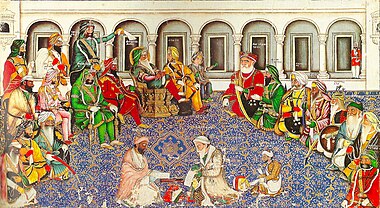 Darbar of Maharaja Ranjit Singh, showing people of all religionsThe Sikh Empire (1801–1849) was forged by Maharajah Ranjit Singh on the foundations of the Khalsa from a collection of autonomous Sikh misls, creating a unified political state. The empire extended from the Khyber Pass in the west, toKashmir in the north, to Sindh in the south, and Tibet in the east. The main geographical footprint of the empire was the Punjab region. The religiousdemography of the Sikh Empire was Muslim (70%), Sikh (17%), Hindu (13%).[23]After his proclamation in 1801 as Maharajah, Ranjit Singh began the modernisation of the Punjab Army. All the Misl leaders who were affiliated with the Army had been nobility, usually with long and prestigious family histories in Punjab.[24][25] Ranjit Singh introduced several new commanders, some of them European, and a further 52,000 well-trained and equipped professional-grade irregulars with a significant multi-religious component. In addition, the army was equipped with field artillery, turning it into a premier fighting force.After Ranjit Singh's death in 1839, the empire was severely weakened by internal divisions and political mismanagement. This opportunity was used by the British Empire to launch the Anglo-Sikh Wars. A series of betrayals of the Sikhs by some prominent leaders in the army led to its downfall. Maharaja Gulab Singh and Raja Dhian Singh were the top generals of the army.[26][27]The Sikh Empire was finally dissolved, after a series of wars with the British at the end of the Second Anglo-Sikh War in 1849, into separate princely states and the British province of Punjab, which were granted statehood. Eventually, a Lieutenant Governorship was formed in Lahore as a direct representative of the British Crown.Punjab Province (British India)[edit]
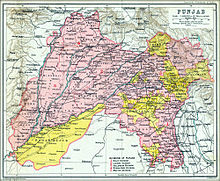 British Punjab Province, before 1947The Cis-Sutlej states, including Kaithal, Patiala, Jind, Thanesar, Maler Kotla, andFaridkot, were under the suzerainty of the Scindhia dynasty of the Maratha Empire, following the Second Anglo-Maratha War of 1803-1805, when Marathas lost this territory to the British. During the war, some of the states in the region gave their allegiance to British General Gerard Lake. At the conclusion of the Second Anglo-Maratha War, an 1809 agreement with Ranjit Singh, ruler of the Sikh Empire west of the Sutlej, brought these states under formal British protection.[22][28][29]Ranjit Singh's death in the summer of 1839 brought political chaos, and the subsequent battles of succession and the bloody infighting between the factions at court weakened the state. By 1845 the British had moved 32,000 troops to the Sutlej frontier to secure their northernmost possessions against the succession struggles in the Punjab. In late 1845, British and Sikh troops engaged near Firozpur, beginning the First Anglo-Sikh War. The war ended the following year, and the territory between the Sutlej and the Beaswas ceded to British Company rule in India, along with Kashmir, which was sold to Gulab Singh of Jammu, who ruled Kashmir as a British vassal.As a condition of the peace treaty, some British troops, along with a resident political agent and other officials, were left in the Punjab to oversee the regency of Maharaja Dhalip Singh, a minor. The Sikh army was reduced greatly in size. In 1848, out-of-work Sikh troops in Multan revolted, and a British official was killed. Within a few months, the unrest had spread throughout the Punjab, and British troops once again invaded. The British prevailed in the Second Anglo-Sikh War, and under the Treaty of Lahore in 1849, the Punjab was annexed by the British East India Company, and Dhalip Singh was pensioned off. The Punjab became a province of British India, although a number of small states, most notably Patiala, Kapurthala, Faridkot, Nabha, and Jind, retained local rulers in subsidiary alliances with the British, with the rulers retaining their own internal sovereignty but recognizing British suzerainty.[30]The Jallianwala Bagh Massacre of 1919 occurred in Amritsar. In 1930, the Indian National Congress proclaimed independence from Lahore. In March 1940, the all-India Muslim League passed the Lahore Resolution, demanding the creation of a separate state from Muslim majority areas in India. The ambiguity of the Lahore Resolution sparked violent protests, in which Punjab became a central stage.[31]In 1946, massive communal tensions and violence erupted between the Punjab's Muslim majority and the Hindu and Sikh minorities. The Muslim League attacked the government of Unionist Punjabi Muslims, Sikh Akalis and the Congress and led to its downfall. Unwilling to be cowed down, Sikhs and Hindus counter-attacked, and the resulting bloodshed left the province in great disorder. Both Congress and League leaders agreed to partition Punjab upon religious lines, a precursor to the wider partition of the country.[32]Independence and its aftermath[edit]
 Rural Sikhs in a long ox-cart train headed towards India. 1947. Margaret Bourke-White.In 1947 the Punjab Province of British India was partitioned along religious lines intoWest Punjab and East Punjab. Huge numbers of people were displaced, and there was much intercommunal violence. Following independence, several small Punjabi princely states, including Patiala, acceded to the Union of India and were united into the PEPSU. In 1956 this was integrated with the state of East Punjab to create a new, enlarged Indian state called simply "Punjab".The undivided Punjab, of which Pakistani Punjab forms a major region today, was home to a large minority population of Punjabi Hindus and Sikhs until 1947, apart from the Muslim majority.[33]Immediately following independence in 1947, and due to the ensuing communal violence and fear, most Sikhs and Punjabi Hindus who found themselves in Pakistan migrated to India as part of the exchange of populations.[34] Punjabi Muslims were uprooted similarly from their homes in East Punjab, which now forms part of India.[35] More than seven million moved to Pakistan, and over six million settled in Punjab.In 1950, two new states were recognised by the Indian constitution: the Indian part of the former British province of Punjab became the state of East Punjab, while the princely states of the region were combined into the Patiala and East Punjab States Union (PEPSU). Himachal Pradesh was later created as a union territory from several princely states in the hills.Formation of current Punjab[edit]The capital city of the undivided Province of Punjab, Lahore, was allocated to the Pakistani West Punjab during the partition of British India in 1947, so a new capital for Indian Punjab was built at Chandigarh. Shimla was named temporary capital of the Punjab until Chandigarh was completed in 1960.After years of protest by Akali Dal and other Sikh organisations, finally Punjab was divided on a linguistic basis in 1966. On 1 November 1966, the Hindi-speaking southern half of Punjab became a separate state, and Haryana and the Pahari-speaking hilly areas in the north became Himachal Pradesh. Chandigarh was on the border between Punjab and Haryana and became a union territory that serves as the capital of both Punjab and Haryana. During the 1970s, the Green Revolution brought increased economic prosperity for the Punjab, mainly due to the late Pratap Singh Kairon. However, a growing polarisation between the Indian National Congress central government and the main Sikh political party, theShiromani Akali Dal, developed during the 1970s. Hostility and bitterness arose from what was widely seen by the Akali Dal as increasing alienation, centralisation and discriminatory attitudes towards Punjab by the Government of India. This prompted the Shiromani Akali Dal to pass the Anandpur Sahib Resolution, which asked for granting maximum autonomy to the region of Punjab and other states and limited role and powers of the Central Government.Geography[edit]Punjab is in northwestern India and has an area of 50,362 square kilometres (19,445 sq mi). It extends from the latitudes 29.30° North to 32.32° North and longitudes 73.55° East to 76.50° East. It is bounded on the west by Pakistan, on the north by Jammu and Kashmir, on the northeast by Himachal Pradesh and on the south by Haryana and Rajasthan.Most of the Punjab lies in a fertile, alluvial plain with many rivers and an extensive irrigation canal system.[36] A belt of undulating hills extends along the northeastern part of the state at the foot of the Himalayas. Its average elevation is 300 metres (980 ft) above sea level, with a range from 180 metres (590 ft) in the southwest to more than 500 metres (1,600 ft) around the northeast border. The southwest of the state is semiarid, eventually merging into the Thar Desert. The Shiwalik Hills extend along the northeastern part of the state at the foot of the Himalayas.The soil characteristics are influenced to a limited extent by the topography, vegetation and parent rock. The variation in soil profile characteristics are much more pronounced because of the regional climatic differences. Punjab is divided into three distinct regions on the basis of soil types: southwestern, central, and eastern.Punjab falls under seismic zones II, III, and IV. Zone II is considered a low-damage risk zone; zone III is considered a moderate-damage risk zone; and zone IV is considered a high-damage risk zone.[37]Climate[edit]
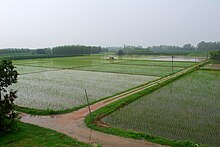 Agricultural fields of Punjab during the monsoonThe geography and subtropical latitudinal location of Punjab lead to large variations in temperature from month to month. Even though only limited regions experience temperatures below 0 °C (32 °F), ground frost is commonly found in the majority of Punjab during the winter season. The temperature rises gradually with high humidityand overcast skies. However, the rise in temperature is steep when the sky is clear and humidity is low.[38]The maximum temperatures usually occur in mid-May and June. The temperature remains above 40 °C (104 °F) in the entire region during this period. Ludhiana recorded the highest maximum temperature at 46.1 °C (115.0 °F) with Patiala and Amritsar recording 45.5 °C (113.9 °F). The maximum temperature during the summer in Ludhiana remains above 41 °C (106 °F) for a duration of one and a half months. These areas experience the lowest temperatures in January. The sun rays are oblique during these months and the cold winds control the temperature at daytime.[38]Punjab experiences its minimum temperature from December to February. The lowest temperature was recorded at Amritsar (0.2 °C (32.4 °F)) and Ludhiana stood second with 0.5 °C (32.9 °F). The minimum temperature of the region remains below 5 °C (41 °F) for almost two months during the winter season. The highest minimum temperature of these regions in June is more than the daytime maximum temperatures experienced in January and February. Ludhiana experiences minimum temperatures above 27 °C (81 °F) for more than two months. The annual average temperature in the entire state is approximately 21 °C (70 °F). Further, the mean monthly temperature range varies between 9 °C (48 °F) in July to approximately 18 °C (64 °F) in November.[38]Seasons[edit]Punjab experiences three main seasons. They are:
Apart from these three, the state experiences transitional seasons like:
Summer[edit]Punjab starts experiencing mildly hot temperatures in February. However, the actual summer season commences in mid-April. The area experiences pressure variations during the summer months. The atmospheric pressure of the region remains around 987 millibar during February and it reaches 970 millibar in June.[38]Rainy season[edit]The monsoon brings joy to the agricultural sector as farmers become very busy. Punjab's rainy season begins in first week of July as monsoon currents generated in the Bay of Bengal bring rain to the region.[38]Winter[edit]Temperature variation is minimal in January. The mean night and day temperatures fall to 5 °C (41 °F) and 12 °C (54 °F), respectively. The winter season in northern Punjab is a blight for the poor who cannot arrange for protection against the cold.[38]Post-Monsoon transitional season[edit]The monsoon begins to reduce by the second week of September. This brings a gradual change in climate and temperature. The time between October and November is the transitional period between monsoon and winter seasons. Weather during this period is generally fair and dry.[38]Post-Winter transitional season[edit]The effects of winter diminish by the first week of March. The hot summer season commences in mid-April. This period is marked by occasional showers with hail storms and squalls which cause extensive damage to crops. The winds remain dry and warm during the last week of March, commencing the harvest period.[38]Rainfall[edit]
Monsoon season provides most of the rainfall for the region. Punjab receives rainfall from the monsoon current of the Bay of Bengal. This monsoon current enters the state from the southeast in the first week of July.[38]
The winter season remains very cool with temperatures falling below freezing at some places. Winter also brings in some western disturbances.[38]Rainfall in the winter provides relief to the farmers as some of the winter crops in the region of Shivalik Hills are entirely dependent on this rainfall. As per meteorological statistics, the sub-Shivalik area receives more than 100 millimetres (3.9 in) of rainfall in the winter months. [38]Flora and fauna[edit]
Agricultural fields of Punjab during the monsoonThe geography and subtropical latitudinal location of Punjab lead to large variations in temperature from month to month. Even though only limited regions experience temperatures below 0 °C (32 °F), ground frost is commonly found in the majority of Punjab during the winter season. The temperature rises gradually with high humidityand overcast skies. However, the rise in temperature is steep when the sky is clear and humidity is low.[38]The maximum temperatures usually occur in mid-May and June. The temperature remains above 40 °C (104 °F) in the entire region during this period. Ludhiana recorded the highest maximum temperature at 46.1 °C (115.0 °F) with Patiala and Amritsar recording 45.5 °C (113.9 °F). The maximum temperature during the summer in Ludhiana remains above 41 °C (106 °F) for a duration of one and a half months. These areas experience the lowest temperatures in January. The sun rays are oblique during these months and the cold winds control the temperature at daytime.[38]Punjab experiences its minimum temperature from December to February. The lowest temperature was recorded at Amritsar (0.2 °C (32.4 °F)) and Ludhiana stood second with 0.5 °C (32.9 °F). The minimum temperature of the region remains below 5 °C (41 °F) for almost two months during the winter season. The highest minimum temperature of these regions in June is more than the daytime maximum temperatures experienced in January and February. Ludhiana experiences minimum temperatures above 27 °C (81 °F) for more than two months. The annual average temperature in the entire state is approximately 21 °C (70 °F). Further, the mean monthly temperature range varies between 9 °C (48 °F) in July to approximately 18 °C (64 °F) in November.[38]Seasons[edit]Punjab experiences three main seasons. They are:
Apart from these three, the state experiences transitional seasons like:
Summer[edit]Punjab starts experiencing mildly hot temperatures in February. However, the actual summer season commences in mid-April. The area experiences pressure variations during the summer months. The atmospheric pressure of the region remains around 987 millibar during February and it reaches 970 millibar in June.[38]Rainy season[edit]The monsoon brings joy to the agricultural sector as farmers become very busy. Punjab's rainy season begins in first week of July as monsoon currents generated in the Bay of Bengal bring rain to the region.[38]Winter[edit]Temperature variation is minimal in January. The mean night and day temperatures fall to 5 °C (41 °F) and 12 °C (54 °F), respectively. The winter season in northern Punjab is a blight for the poor who cannot arrange for protection against the cold.[38]Post-Monsoon transitional season[edit]The monsoon begins to reduce by the second week of September. This brings a gradual change in climate and temperature. The time between October and November is the transitional period between monsoon and winter seasons. Weather during this period is generally fair and dry.[38]Post-Winter transitional season[edit]The effects of winter diminish by the first week of March. The hot summer season commences in mid-April. This period is marked by occasional showers with hail storms and squalls which cause extensive damage to crops. The winds remain dry and warm during the last week of March, commencing the harvest period.[38]Rainfall[edit]
Monsoon season provides most of the rainfall for the region. Punjab receives rainfall from the monsoon current of the Bay of Bengal. This monsoon current enters the state from the southeast in the first week of July.[38]
The winter season remains very cool with temperatures falling below freezing at some places. Winter also brings in some western disturbances.[38]Rainfall in the winter provides relief to the farmers as some of the winter crops in the region of Shivalik Hills are entirely dependent on this rainfall. As per meteorological statistics, the sub-Shivalik area receives more than 100 millimetres (3.9 in) of rainfall in the winter months. [38]Flora and fauna[edit] Agriculture in PunjabThe plains of Punjab do not have any thick forests. The only available flora are patches of grass, small bushes, and shrubs. In the southeastern part of Punjab and the areas of Gurdaspur, Hoshiarpur and Multan, mangoes are grown. Other varieties of fruit grown in abundance are oranges, apples, figs, quinces, almonds,pomegranates, peaches, mulberries, apricots and plums.Major cultivation of rich flora and fauna can be seen in the Shivalik ranges. Due its rich flora and fauna, it has been termed a micro-endemic zone of India. There is a wide variety of angiosperms in the area, including 355 types of herbs, 70 types of trees, 70 types of shrubs of all sizes, 19 types of climbers, and 21 types of twines. Besides angiosperms, the region is home to 31 kinds of pteridophytes and 27 kinds of bryophytes, while a special species of gymnosperm named Pinus roxburghii can be seen in the ranges of Punjab.The fauna of the area is rich, with 396 types of birds, 214 kinds of Lepidoptera, 55 varieties of fish, 20 types of reptiles, and 19 kinds of mammals. The state of Punjab has large wetland areas, bird sanctuaries that house numerous species of birds, and many zoological parks. Wetlands include the national wetland Hari-Ke-Pattan, the wetland of Kanjli, and the wetlands of Kapurthala Sutlej. Wildlife sanctuaries include the Harike in the district of Tarn Taran Sahib, the Zoological Park in Rupnagar, Chhatbir Bansar Garden in Sangrur, Aam Khas Bagh in Sirhind, Amritsar’s famous Ram Bagh, Shalimar Garden in Kapurthala, and the famous Baradari Garden in the city of Patiala.[39]Animals and birds[edit]A few of the rivers in Punjab have dangerous species of crocodiles. The extraction of silk from silkworms is another industry that flourishes in the state. Production of bee honey is done in some parts of Punjab. The southern plains are desert land; hence, camels can be seen. Buffaloes graze around the banks of rivers. The northeastern part is home to animals like horses. The desert area has dangerous species of snakes like the cobra and sangehur. Wildlife sanctuaries have many more species of wild animals like the otter, wild boar, wildcat, fruit bat, hog deer, flying fox, squirrel and mongoose.Naturally-formed forests can be seen in the Shivalik ranges in the districts of Ropar, Gurdaspur and Hoshiarpur. Patiala is home to the Bir forest while the wetlands area in Punjab is home to the famous Mand forest.[40]Botanical gardens exist throughout Punjab. There is a zoological park and a tiger safari park, as well as three parks dedicated to deer.[40]The state bird is the baz (northern goshawk).[41] (Melierax poliopterus), the state animal is the blackbuck (Antilope cervicapra), and the state tree is the shisham (Dalbergia sissoo).[36]Government and politics[edit]
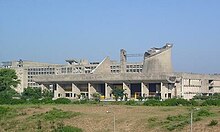 Punjab Legislative AssemblybuildingMain articles: Politics of Punjab (India), Government of Punjab (India), Punjab Legislative Assembly and List of districts of Punjab (India)Each of the states of India possesses a parliamentary system of government, with a ceremonial state Governor, appointed by the President of India on the advice of the central government. The head of government is an indirectly elected Chief Ministerwho is vested with most of the executive powers. The state legislature, the Vidhan Sabha, is the unicameral Punjab Legislative Assembly, with 117 members elected from single-seat constituencies. The capital of Punjab is Chandigarh, which also serves as the capital of Haryana and is thus administered separately as a Union Territory of India. The judicial branch of the state government is provided by thePunjab and Haryana High Court in Chandigarh.[42] The current Government was elected in the 2012 Assembly elections as the coalition of SAD and the BJP won 68 out of 117 Assemble seats and Prakash Singh Badal of the Shiromani Akali Dal is the current Chief Minister.The state of Punjab is divided into five administrative divisions and twenty-two districts.Subdivisions[edit]
 Districts of Punjab along with their headquarters, before 2007The area of Punjab can be divided into:
Administrative subdivisions[edit]Main article: Districts of Punjab, IndiaThe state of Punjab has 22 districts which comprise subdivisions, tehsils and blocks.
Districts of Punjab along with their headquarters, before 2007The area of Punjab can be divided into:
Administrative subdivisions[edit]Main article: Districts of Punjab, IndiaThe state of Punjab has 22 districts which comprise subdivisions, tehsils and blocks. Burning of rice residues after harvest to quickly prepare the land forwheat planting, around Sangrur, PunjabPunjab's GDP is ₹3.17 lakh crore (US$47 billion). Punjab is one of the most fertile regions in India. The region is ideal for wheat-growing. Rice, sugar cane, fruits andvegetables are also grown. Indian Punjab is called the "Granary of India" or "India's bread-basket".[43] It produces 10.26% of India's cotton, 19.5% of India's wheat, and 11% of India's rice. The Firozpur and Fazilka Districts are the largest producers of wheat and rice in the state. In worldwide terms, Indian Punjab produces 2% of the world's cotton, 2% of its wheat and 1% of its rice.[43] The largest cultivated crop iswheat. Other important crops are rice, cotton, sugarcane, pearl millet, maize, barleyand fruit. Rice and wheat are doublecropped in Punjab with rice stalks being burned off over millions of acres prior to the planting of wheat. This widespread practice is polluting and wasteful.[44] In Punjab the consumption of fertiliser per hectare is 223.46 kg as compared to 90 kg nationally. The state has been awarded the National Productivity Award for agriculture extension services for ten years, from 1991–92 to 1998–99 and from 2001 to 2003–04. In recent years a drop in productivity has been observed, mainly due to falling fertility of the soil. This is believed to be due to excessive use of fertilisers and pesticides over the years. Another worry is the rapidly falling water table on which almost 90% of the agriculture depends; alarming drops have been witnessed in recent years. By some estimates, groundwater is falling by a meter or more per year.[45][46]According to the India State Hunger Index, Punjab has the lowest level of hunger in India.[47]
No comments:
Post a Comment